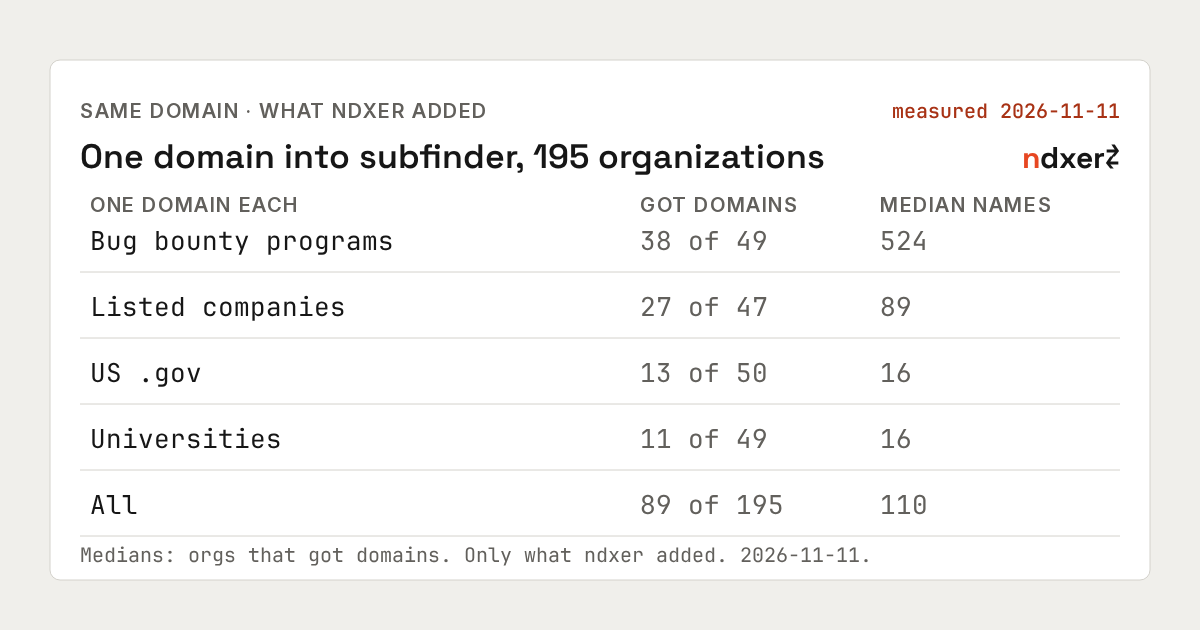
What ndxer added
On 2026-11-11 we gave subfinder one domain for each of 195 organizations and ran it twice, back to back: plain, then with an ndxer key. 49 of the organizations are public bug bounty programs. For 38 of those 49, ndxer added other domains that the same owner runs. A plain run can't return them, because subfinder lists names under the domain you type and nowhere else.
The typical program of those 38 got 6 more domains and 524 names under them (medians). For scale, plain subfinder's baseline for the same 38 programs was a median of 461 names under the typed domain. On 22 of them, the names under the added domains outnumbered everything plain subfinder found under the domain we typed. 28 of the 49 programs got 100 or more added names.
Every added domain arrives with the DNS value that ties it to your target. Often that value sits under the target's own name: its name server, its SOA contact. You can check it in ten seconds.
ndxer also returned names under the typed domain itself that no other source returned in this run: on all 49 programs, a median of 8.
The short version. On 2026-11-11, with one domain per program, ndxer added other domains of the same owner for 38 of 49 bug bounty programs: a median of 6 domains and 524 names under them, none of which plain subfinder returns. Universities and .gov mostly got no other domains. Same owner does not mean in scope, so check the program's policy first.
Across all 195 organizations, ndxer added 1,830 domains and 202,128 names under them on 2026-11-11. That total is lopsided: three organizations (HubSpot, Cisco Meraki and Tencent's qq.com) account for 67% of it, and much of HubSpot's and Tencent's share is their customers' content. That is why every number above is a median or a count of programs.
By list
The four lists behave very differently, in the order you'd guess: companies with many brands and acquisitions gain the most, and organizations that run one domain gain little.
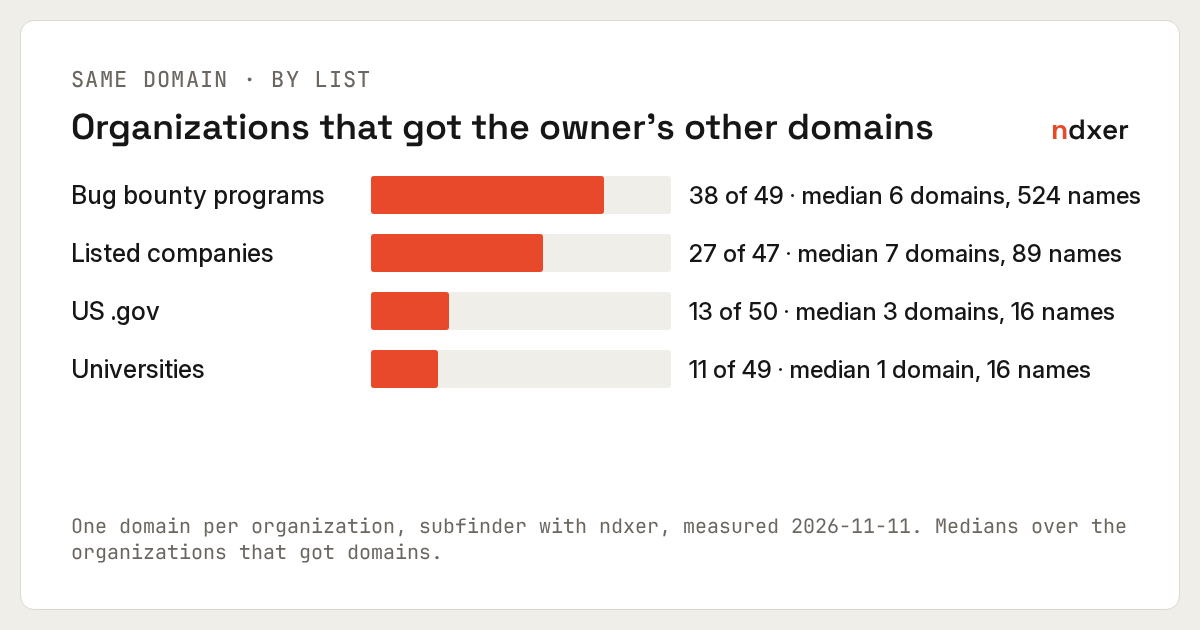
The same run as a table. The first four number columns are what ndxer added. The last one is plain subfinder's baseline for the same organizations, so you can see the size of what was already there.
| List (2026-11-11) | Got other domains | Median domains added | Median names under the added domains | Got names under the typed domain only ndxer returned in this run | Plain subfinder, median names under the typed domain (baseline) |
|---|---|---|---|---|---|
| Bug bounty programs | 38 of 49 | 6 | 524 | 49 of 49 | 461 |
| Listed companies | 27 of 47 | 7 | 89 | 35 of 47 | 200 |
| US .gov | 13 of 50 | 3 | 16 | 46 of 50 | 28 |
| Universities | 11 of 49 | 1 | 16 | 42 of 49 | 39 |
| All 195 | 89 of 195 | 5 | 110 | 172 of 195 | 172 |
Medians of domains and names are over the organizations that got other domains, and the baseline is over the same organizations. Across all 49 bug bounty programs, plain subfinder's median was 295 names.
Four programs, with the evidence
These four are from the 2026-11-11 run. The evidence for each domain is what the build printed for it.
Dell. Plain subfinder returned 3,260 names under dell.com. ndxer added 109 domains and 1,227 names under them. Among them: wysemanagementsuite.com (333 names), delltechnologies.com (247), vce.com (100), dellemc.com (96) and emc.com (82). Each one publishes pkiadmin@dell.com as its SOA contact, an address under the target's own name. EMC and VCE came with a merger, and an acquired company's old estate is where forgotten hosts tend to sit.
Goldman Sachs. Under gs.com, plain subfinder's baseline was 1,681 names. ndxer added 53 domains and 957 names: marcus.com (245), goldman.com (119), gsam.com (71), goldmansachs.cn (71), login.gs (52) and honestdollar.com (62), a retirement-savings startup the bank bought and later wound down. All of them publish ns1.gs.com as a name server. A product that was shut down and still has 62 names under it is the kind of domain nobody puts on a scope page.
ResMed. ndxer added 75 domains and 1,174 names to resmed.com, whose plain baseline was 897. Five of them share one Atlassian verification token: resmed.eu (109 names), resmed.com.au (62), citushealth.com (101), matrixcare.com (86) and propellerhealth.com (53). The last three are health-tech companies ResMed bought. A vendor token is weaker evidence than a name server, and the next sections say how to judge it. Here the same token sits on ResMed's own country domains, which tells you whose Atlassian account it is.
Cisco Meraki. Plain subfinder returned 10,475 names under meraki.com. ndxer added 6 domains, and they hold 41,002 names: cisco.com (39,559), splunk.com (744), samknows.com (617), appdynamics.com (39) and slido.com (19), all sharing one Miro verification token with meraki.com. One subsidiary's collaboration account leads to the parent and four companies it bought. None of that is in Meraki's program, which is the point of the scope callout below.
Where it falls short
Universities and .gov domains mostly gained no other domains. On 2026-11-11, 11 of 49 universities got any, with a median of 1 domain and 16 names; 13 of 50 .gov domains did, with a median of 3 domains and 16 names. Where an organization runs one domain, there is nothing more to find, and the run says so. Where every value a domain publishes belongs to a shared provider, nothing points at an owner, and ndxer adds nothing rather than guess.
Even there, most got a few names under their own domain that no other source returned in this run: 42 of 49 universities (median 7) and 46 of 50 .gov domains (median 5). The .gov gains, when they come, can be large: usps.gov brought in usps.com and its 1,199 names, through the contact address domainadmin@imail.usps.gov. A university that runs its own name servers can gain a lot too; on 2026-11-10, one university got 165 domains.
Two things inflate the counts, and you should discount them:
- Customer content.
hubspot.netalone holds 77,173 of HubSpot's added names, and a large part of them are customer sites HubSpot hosts. Underqq.com,myqcloud.comadds 9,866 names that are largely Tencent Cloud customers' storage and CDN names. The owner is the same; the hosts mostly aren't theirs to test. - Defensive registrations.
myfitnesspal.comgot 79 domains with 77 names under them, nearly all country domains with one name each. Count names, not domains.
Check the evidence
Some of what ndxer classes as the same owner isn't. utalca.cl, the Universidad de Talca, got uantof.cl with 75 names, because both publish the same KnowBe4 verification token. uantof.cl is a different university. The same vendor put ohiosos.gov next to a set of Ohio county sites, most likely through one state contract. These domains are in the totals above, which count every domain ndxer classed as the same owner. On 2026-11-11, 22,085 of the added names, across 32 organizations, sat under domains whose only evidence was a vendor verification token or a DKIM key. Many of those are right (ResMed, Meraki). They are the ones to check first.
How to read the ndxer_why line:
- "Publishes ns1.example.com, under the seed's own name." A name server, mail host or SOA contact under the target's own domain. Strong: someone with access to the target's DNS set it.
- "Shares the verification token …, issued to one account." One account at a vendor (Atlassian, Miro, Adobe, KnowBe4) verified both domains. The account belongs to whoever set it up, which can be the company, its agency or a state office buying training for every county. Look at which other domains carry the token. If the target's own country domains do, it's the target's account. If another institution shows up, it isn't.
- "Same name as the seed (example)." The same label under another suffix. Often a defensive registration, sometimes a whole hosting platform.
The name of a domain doesn't decide it. alphabet.com under bmw.de looks like a mistake, and it publishes ns.bmw.de: it is BMW's leasing business, with 132 names under it on 2026-11-11.
Same owner is not in scope.
cisco.comis not Meraki's program. Read the program's policy before you send a single request to an added domain: many programs include acquisitions, many exclude them. When the policy is unclear, ask, and send thendxer_whyline and the evidence with the question.
How a researcher uses it
Run what you always run, with JSON output:
subfinder -d example.com -oJ -cs -o out.jsonlHosts under the domain you typed have no ndxer_seed. Hosts under a domain ndxer added carry the domain you typed, the class and the reason. List the added domains once each, with the reason:
jq -r 'select(.ndxer_seed != null) | [.input, .ndxer_why] | @tsv' out.jsonl | sort -uexample.net Publishes ns1.example.com, under the seed's own name.
example.org Shares the verification token example-site-verification=Q2xhdWRlIGV4YW1wbGUgdG9rZW4, issued to one account.Take that list to the program's policy. Say example.net is in scope and example.org isn't mentioned. Send only the approved domain's hosts on:
jq -r 'select(.input == "example.net") | .host' out.jsonl | httpx -silenthttps://www.example.net
https://api.example.netexample.org waits until the program answers. Its JSON lines carry the evidence, with how many domains publish each value, ready to paste into the question.
How we measured
- Targets. 195 organizations, one domain each, from four public lists: 49 bug bounty programs from a public program list, 50 domains from the US .gov registry, 49 universities from a registry of research organizations, and 47 listed companies from a public knowledge base.
- Runs. On 2026-11-11, each domain went through
subfinder -d <domain> -oJ -cstwice, back to back: once plain, with no keys for any source, and once withNDXER_API_KEYset. Default sources, default related classes (subjectonly). The build is thendxerbranch of github.com/southax/subfinder, sha2564dbf805c28acafd13168422b008e873b622f3a59e13987846b464dfa8910dc68. - What counts as added. Every name under a domain that only ndxer supplied, whichever source listed it, and every name under the typed domain that only ndxer returned in the with-ndxer run. Both come from that run's own source attribution (
-cs). We didn't subtract one run from the other: the free sources return different results from one run to the next, so that difference would measure them, not ndxer. - What didn't answer.
crt.namereturned errors for the whole run. The plain baseline is smaller than on a day it answers, and some names counted as "only ndxer returned in this run" may come back from it on another day. - Totals. 1,830 added domains and 202,128 names under them, 67% of which come from three organizations: HubSpot 77,276, Cisco Meraki 41,002, Tencent 17,899. Plain subfinder's baseline across all 195 was 87,537 names.
- Cost. All 195 runs with ndxer used 3,497 units together, about 18 per organization. An organization with many related domains costs more, because the ndxer source pays per page for each domain it runs on. The banner prints each run's charge.
Try it
The build is at github.com/southax/subfinder. Its README has the install, the key setup, the flags and the JSON fields, and it stays current as the build changes. You need a key from your API keys page. To check our numbers, run a program you know plain and then with the build, and compare what carries an ndxer_seed.
What it changes on a program
A scope page lists the domains someone at the company remembered to write down. The company runs more: the brands it bought, the products it shut down, its country sites. On 38 of 49 programs on 2026-11-11, one typed domain led to some of them, each with the DNS value that ties it to the target.
That gives you two jobs subfinder didn't give you before. Read the evidence, and ask the program about the domains it never listed. Start with a program you know well: the domains you recognize tell you how far to trust the ones you don't.