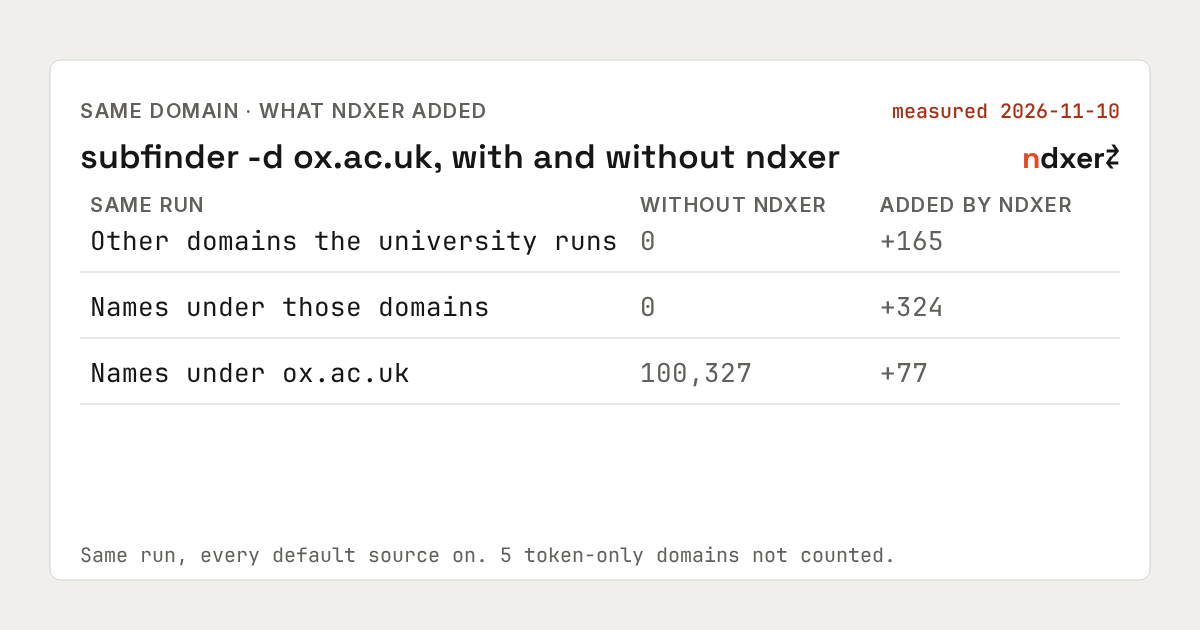
Corrected 2026-11-11. The first version led with the 100,404 names under
ox.ac.uk, almost all of which plain subfinder returns on its own. It also counted 170 related domains and 344 names under them, including 5 domains that aren't the university's. This version reports only what ndxer added, and the numbers above are the corrected ones.
One domain in
There is now a build of subfinder with ndxer in it. It does everything subfinder did, plus two things: it adds the other domains that share DNS values with yours and runs every source on them as if you had typed them, and it adds an ndxer source for the names under your domain.
On 2026-11-10 we typed one domain into it, ox.ac.uk, with every default source on. This is what ndxer added to that run:
- 165 other domains the university runs. Plain subfinder can't return these, because it only looks under the domain you type.
- 324 names under those domains. The sources you already use found most of them, once ndxer had handed them the domains.
- 77 more names under
ox.ac.ukthat no other source in the run returned.
The same run without ndxer returned 100,327 names under ox.ac.uk and nothing else. They come from subfinder's free sources, none of which needs a key, so if you run subfinder -d ox.ac.uk yourself you'll get roughly the same pile. ndxer adds little to that pile. What it adds is the rest of the university.
165 domains you wouldn't have typed
Before the sources start, the build asks ndxer which other domains share values with the one you typed. For ox.ac.uk the banner listed 170, and 165 of them are the university's:
- 148 use both of the university's name servers and carry its own SOA primary and
hostmastercontact. That is about as strong as DNS evidence gets. - 9 use the two name servers alone.
- 7 also route their mail through the university's own mail filtering.
- 1 sits on three more of the university's name servers.
They are research projects, clinical trials, institutes, museums and centers, each on its own domain: 79 .org, 33 .ac.uk, 14 .org.uk, 11 .com, 10 .co.uk, a handful of others and one .edu. Only 13 of the 165 have "ox" in the name. Nobody would guess most of them from ox.ac.uk, and a plain run never sees them.
The other 5 share nothing but one certificate verification token. They aren't the university's, and the next sections leave them out.
324 names under them
Once the build had the domains, every source went to work on them. Under the 165 they returned 324 names, across 138 of the domains; the other 27 returned nothing. ndxer's own source listed 144 of the 324, and 6 of them only ndxer had. The certificate-log and other free sources returned the rest.
So ndxer's main job here was to supply the domains, and the sources you already use did most of the listing. Without the domains, they had nothing to look under.
77 more names under ox.ac.uk
ndxer returned 77 names under ox.ac.uk that no other source in the run had. 75 of them are names that other names point to with a CNAME: the backend behind an alias. A certificate carries the name people type, so certificate logs tend to show the alias and not the host behind it. The other 2 are mail policy records.
We grouped them by name:
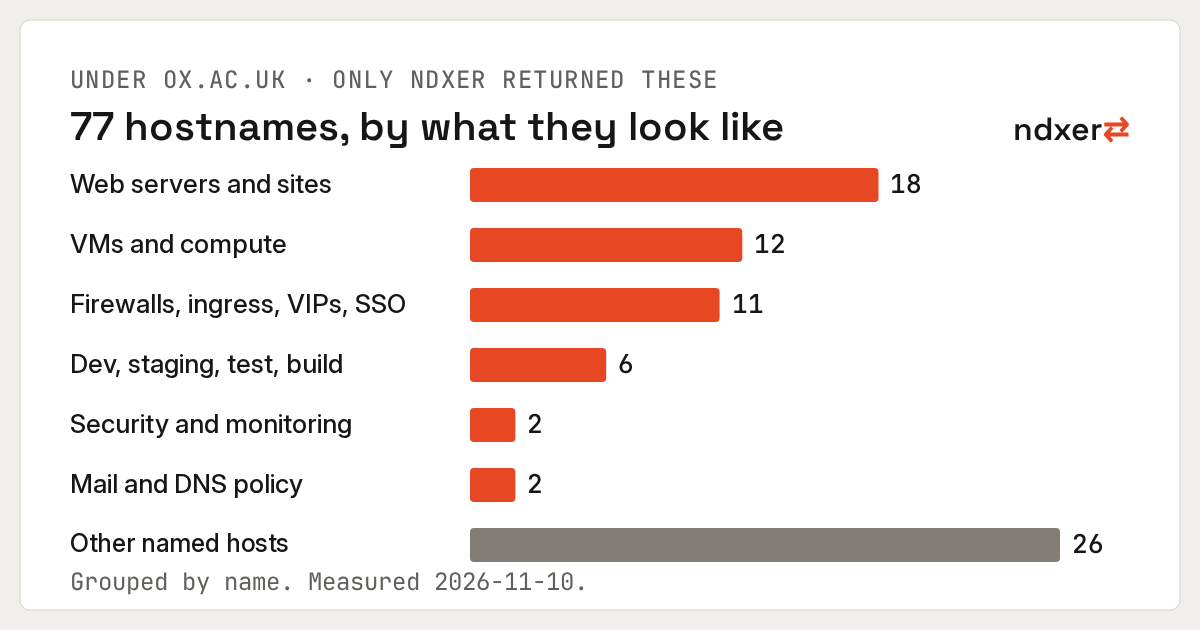
Web servers, staging and build hosts, an SSO proxy, ingress controllers. Two of them had no record of their own when ndxer last checked them; they exist only as the target of another name's CNAME.
77 is small next to 100,327, and it depends on the run: it counts what no other source returned that day. Run it yourself and the number will move a little.
We aren't listing the names here. There are clear naming patterns in them, the kind that tell you how a department names its staging boxes. If you want to see them, sign up and look ox.ac.uk up yourself.
Check the evidence
The 5 domains that share only a certificate verification token are why every domain comes with its evidence. A GlobalSign verification token belongs to whoever ordered the certificates, and that is often a reseller, a platform or an agency working for several customers. These five aren't the university's, and the 20 names the sources found under them aren't in any number above. The banner still lists them, with what they share, so you can judge for yourself.
The banner shows what each group shares, and with -oJ every host carries the same evidence:
{"host":"www.example.net","input":"example.net","ndxer_seed":"example.com","ndxer_class":"subject","ndxer_why":"Publishes dns0.example.com, under the seed's own name.","ndxer_evidence":[{"kind":"ns_host","key":"dns0.example.com","n":166},{"kind":"soa_rname","key":"hostmaster@example.com","n":157}]}n is how many domains publish that value. A name server under the target's own name, shared by 166 domains, is strong. A token shared by a handful of unrelated domains is weak, however small its n is.
A related domain is a lead. Check the program's scope before you send a single request to it. The evidence in the banner and the JSON line is what you show the program when you ask.
The same domain in ndxer
The banner is a summary. Every domain in it can be opened in ndxer, with the values behind it. These captures are from 2026-11-08, two days before the run above.
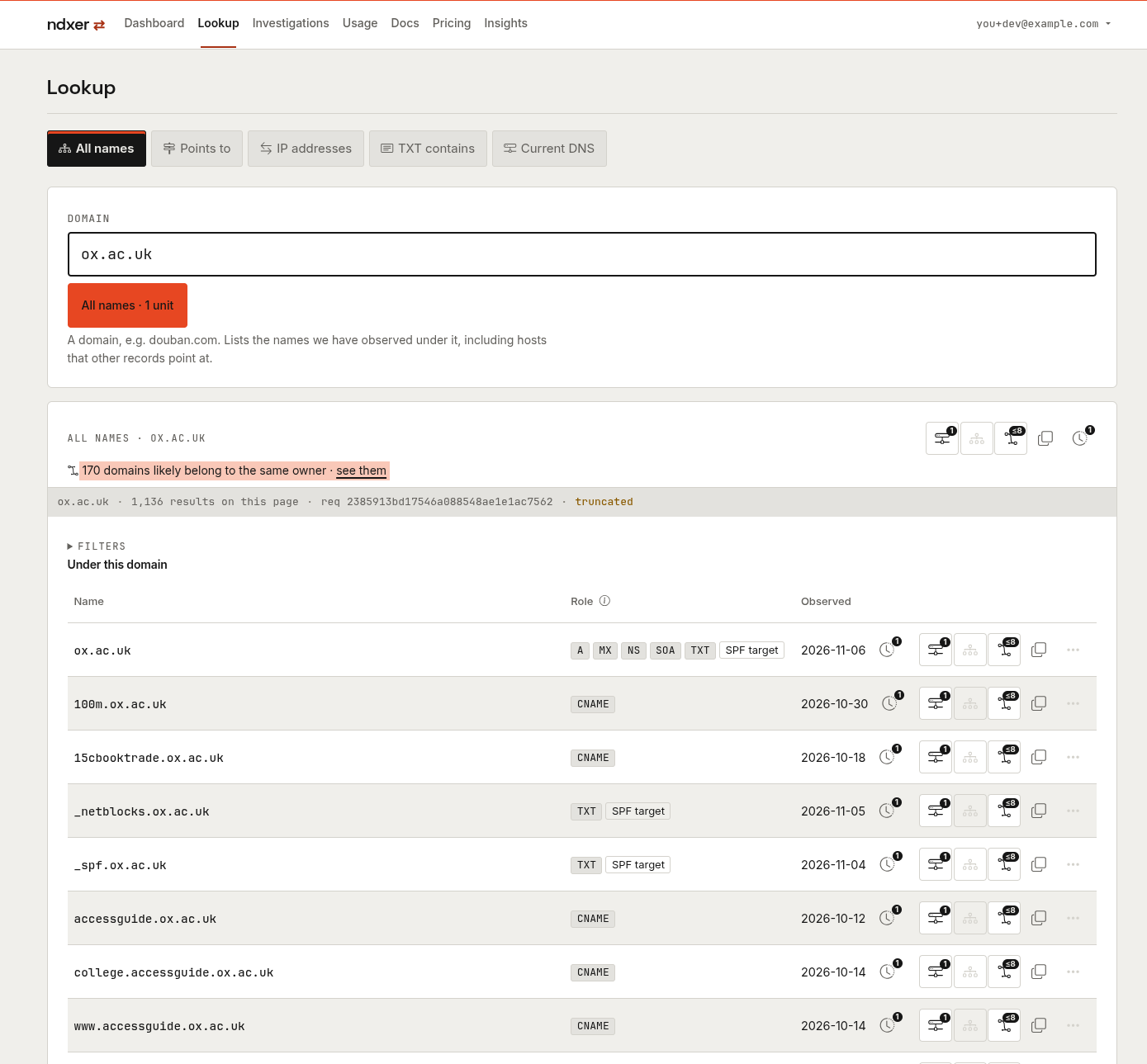
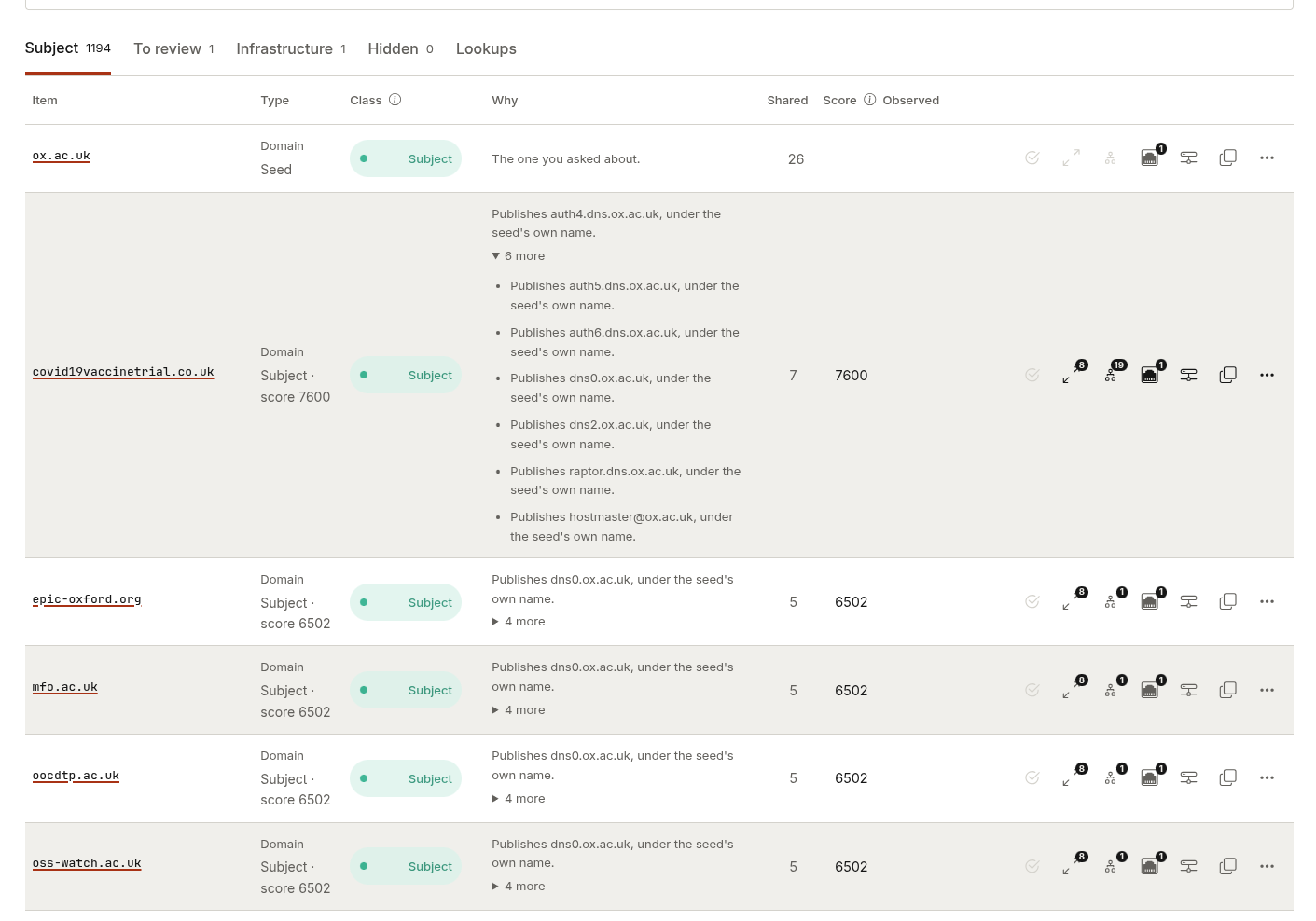
All names lists what we hold under ox.ac.uk, each name with its record types and when it was last observed. Above the table, one line says 170 domains likely belong to the same owner, the 5 weak ones included. That line is what the subfinder build acts on.
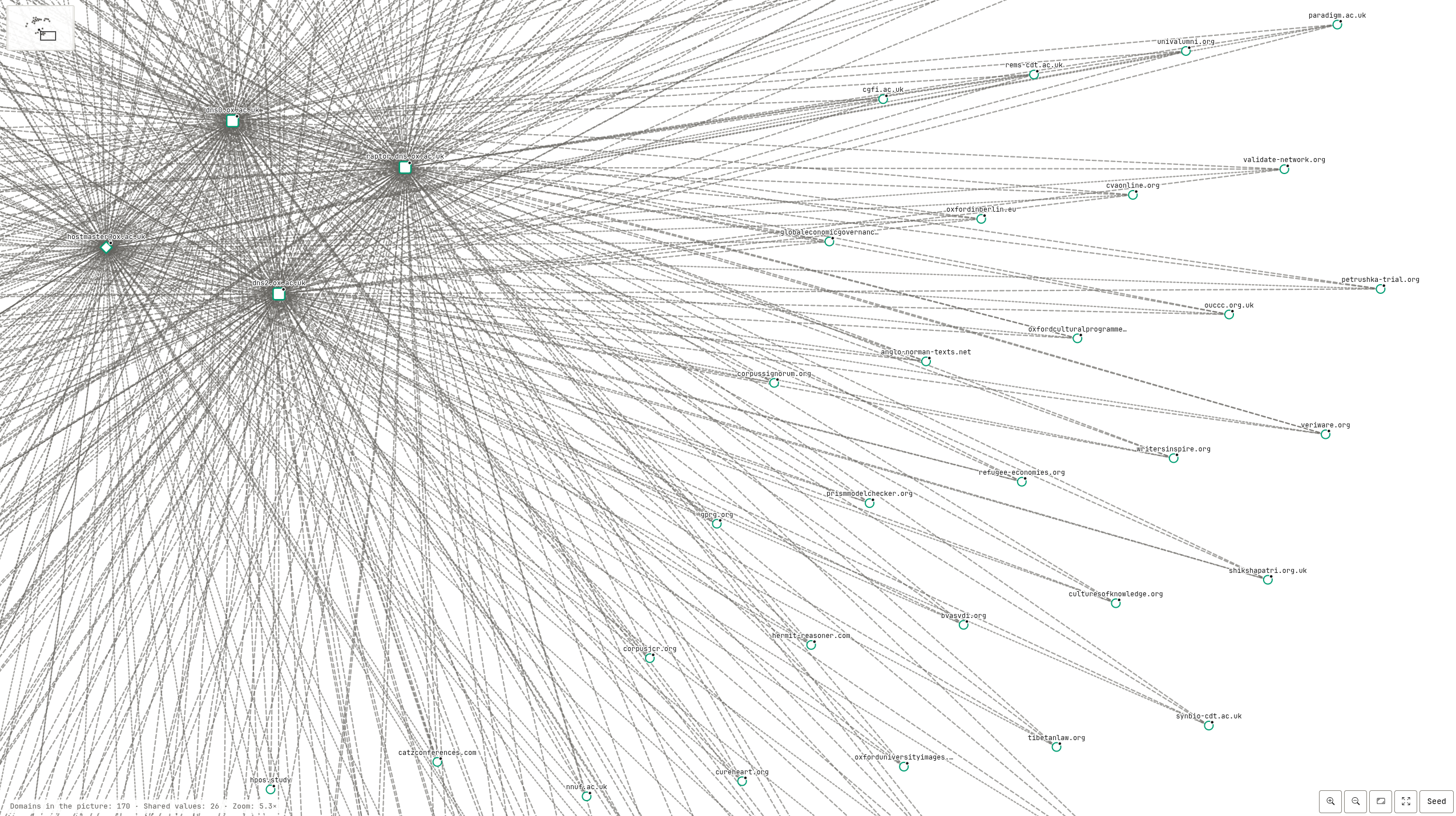
Investigations draws the domains around the values they share with ox.ac.uk. The hubs they gather around are name servers and a contact address under the university's own name.
The table gives each domain its reason in words, how many of the seed's values it publishes and a score that orders the rows. The top row shared 7 values with ox.ac.uk. Values that belong to a shared provider score nothing and sit in a tab of their own.
What a run looks like
A recording from 2026-11-08, with only the ndxer source on. The related domains go through the run one after another. Most of the names it prints under ox.ac.uk the free sources return too; the related domains are the part they don't.
Try it
The build is at github.com/southax/subfinder. Its README has the install, the key setup, the flags and the output fields, and it stays current as the build changes. Every source and flag you already use works the same. You need a key from your API keys page, and the banner states the units each run uses. With every source on, the ox.ac.uk run took about 12 minutes, most of it spent on the extra domains. The build is also listed on the Integrations page.
To see the difference yourself, run subfinder -d ox.ac.uk plain and then with the build, and compare.
What one domain gets you
Typing one domain used to get you the names under that domain, and plain subfinder still does that well. With this build it also gets you the other domains the same organization runs, and the names under them. For ox.ac.uk that meant 165 domains and 324 names a plain run never touches, plus 77 backend names the other sources missed.
Start with a target you know. You will recognize most of the domains in the banner, which tells you how far to trust the ones you don't.